

Retired Aircraft Cuts
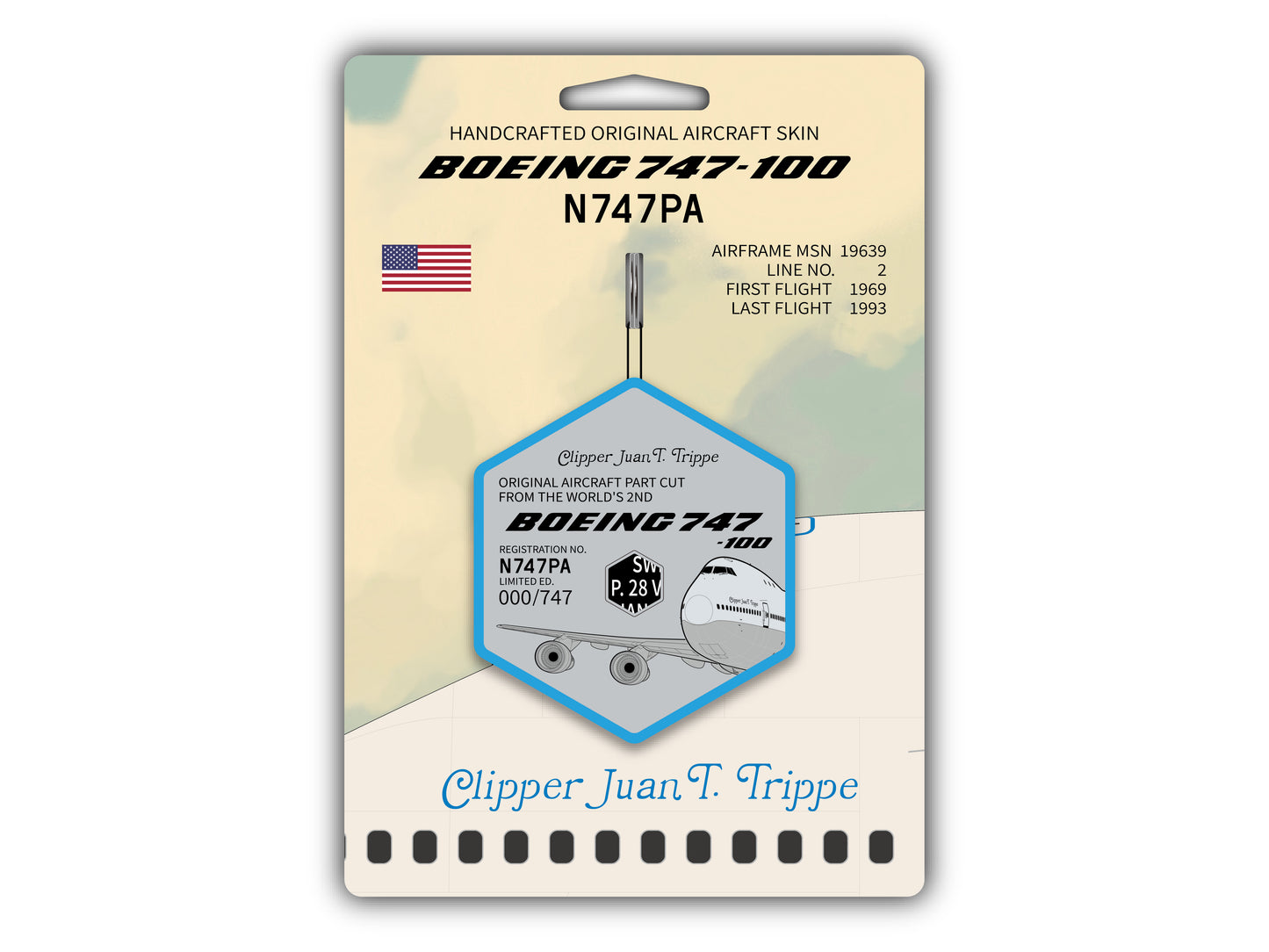
Boeing 747-100 ex-N747PA
Boeing 747-100 ex-N747PA
Note
- The tag will cost between 500-2000 Airlinertags Points (AP), please ensure your account currently has enough AP for redemption.
- Please redeem via Airlinertags Points system.
- Redemption can be combined with existing order, or cost extra postage.
Description
The Boeing 747 "Jumbo Jet" is commonly considered as the most famous and iconic aircraft in human history. It was born with a legendary exchange back in 1965 when Juan Trippe, the head of Pan Am asked Bil Alen, the president of Boeing for an airliner 2.5 times the size of the Boeing 707 during a fishing trip in Alaska. "If you build it, I'l buy it" said Trippe, to which Alen replied: "If you buy it, I'l build it".
Today, it has been decades since PAN AM ceased operations in 1991, but the airline is stil widely acknowledged as the most iconic airline in human history. And the one aircraft that brought PAN AM to its peak, is the Boeing 747. As the major launch customer of the Boeing 747, PAN AM placed a huge order of 25 Boeing 747s on Boeing's 50th Anniversary in 1966, starting a new chapter of the jet age caled "The Jumbo Jet".
As the first Boeing 747 prototype RA001 took its first flight February 9, 1969, the second Boeing 747 prototype RA002 was also being prepared for its day. As the it's completed on February 28, 1969, the Boeing 747-121 MSN 19639 rolled off the assembly line in Everett as the first commercial Boeing 747 ever built on March 5, 1969. Painted in the iconic PAN AM livery in the classic PAN AM baby blue, the brand-new airliner received a special name "Jet Clipper America" and a special registration number: N747PA. Boeing made a perfect demonstration that day by parking a PAN AM Boeing 707-321B, specificaly N410PA next to N747PA, alowing people to understand the actual size of the giant Boeing 747.
It's quite interesting to seek the origin of the registration number N747PA. In 1955, PAN AM placed an order of 20 Boeing 707s and 25 Douglas DC-8s, launching N7XXPA and N8XXPA registration numbers just like what they did to the Douglas DC-6s (launching N6XXPA as the first time using NXXXPA type of registration numbers). We believe that PAN AM decided to reserve N707PA~N730PA for the original Boeing 707 orders and future Boeing 707 airframes (lately more Boeing 707s took N701PA~N706PA as well), meanwhile using N777PA as their first Douglas DC-7s being delivered the same year to emphasise the number "7" of Douglas DC-7 (well, they had no idea about the Boeing 777 at al anyway). The problem is when PAN AM ran out of N771PA~N777PA numbers, they chose to use N731PA as smaller numbers were reserved for the Boeing 707s. The numbers used by Douglas DC-7s eventually stopped at N756PA when PAN AM stopped taking them from Douglas.
With the Douglas DC-7s being phased out in the mid-60s, it makes perfect sense to reassign the numbers N731PA to N755PA to the 25 Boeing 747 orders in 1966, as is contains N747PA, and PAN AM likes to define flagships this way, just like they did to the Boeing 707 N707PA, Douglas DC-6 N600PA, Douglas DC-7 N777PA and Douglas DC-8 N800PA. Now let's get back to the 25 Boeing 747s MSN 19637~19661, based on the information we gathered, PAN AM decided to start the registration number from N747PA to N755PA for MSN 19637~19645, and distribute N731PA to N746PA for MSN 19646~19661, just like what they did to the Boeing 707s (starting with N707PA~N730PA, using N701PA~N706PA later on). But this may cause difficulty for employees to estimate the age of different airframes, so PAN AM changed their mind, alowing their first 747 to use N747PA, lining up the rest and registering them in an order of MSN increasing. In this scenario MSN 19637 should be N747PA, while MSN 19639 should be N732PA. Things were planned this way, as MSN 19639 was indeed registered as N732PA at the FAA.
However, the construction of both MSN 16937 and 19638 didn't start as planned, probably due to design changes (as the Joe Sutter team was on a really tight schedule). Boeing turned to build MSN 19639 instead. As a result, when MSN 19639 was rolled out March 5, 1969, PAN AM had to paint this airframe as N747PA while it was still registered as N732PA. There was no problem to do so at al, as this airframe hasn't lifted off yet. Boeing notified the FAA about this change on April 7, 1969, four days later, on April 11, 1969, MSN 19639 was finally re-registered as N747PA legally.
On April 11, 1969, N747PA took its first flight with four Pratt & Whitney JT9D-3A high-bypass-ratio turbofan engines installed. Onboard were Mrs. Florine Crockett, Chief of the Technical Section, and Boeing Test Pilot Brian Wygle and PAN AM Captain Scott Flowers. Since the Boeing 747 hasn't received its FAA airworthiness certificate yet, N747PA could not be delivered to PAN AM, instead it was firstly used for Pan Am's Crew training purposes with a Special Airworthiness Certificate. The application of such a certificate stated that N747PA had already accumulated 3 hours and 28 minutes of flight time by April 14, 1969. Later on, N747PA became one of the five test 747s Boeing used in a 4,000-hour shakedown program. Remarkably, stickers of number "2" combined with the PAN AM Globe were applied to both sides of the nose of N747PA in 1969, leaving us with a few photos and footages as additional evidence of its special importance in the early days.
On December 30, 1969, FAA officialy granted the Boeing 747-100 its Type Certificate A20WE, certifying it for commercial operations. During that time, N747PA was finally able to have a promotional tour, performing low-passes, courtesy flights and offering static displays at Honolulu, San Francisco, Los Angeles, Miami, Philadelphia, Bermuda, Boston and Texas. With tens of thousands of visitors trooping through the massive cabin,N747PA with the easy-to-recognise registration quickly became the focus of the public.
Continued tests were conducted before the summer of 1970 when N747PA was returned to the Boeing assembly plant in Everett where technicians removed the various test equipment from the interior and outfitted the aircraft for passenger service in a F25C52Y304 cabin configuration. Shortly before the deliverey, the aircraft was renamed "Clipper America" without "jet".
On October 3, 1970, Bernard Lawrence, PAN AM resident representative in Seattle, accepted the keys to N747PA from James Austin of Boeing, marking the delivery of N747PA 540 days after its first flight, starting its service as the flagship of the PAN AM fleet. PAN AM paid US$24 milion for N747PA(US$212 milion in 2025 dolars). The empty weight of N747PA was 319,440 pounds (144,896 kg) at the time of delivery, this number later became 322,300 pounds (146,193 kg) with the interior being modified by PAN AM.
At that time, there were around 20 Boeing 747 destinations according to the PAN AM September/October Timetable, among which are US cities including New York, Chicago, Washington, Boston, San Francisco, Los Angeles, Honolulu, and European cities including London, Frankfurt, Paris, Amsterdam, Brussels, Rome, Lisbon, Barcelona, and other cities including Bermuda/San Juan/Hong Kong/Tokyo. It didn't take a long time for N747PA to be familiar with al these routine flight missions and logged 2898 hours and 27 minutes of airborne time.
And then things went wrong.
On July 30, 1971, N747PA was taking off for Tokyo Haneda from San Francisco as part of flight PAN AM 845 LAX-SFO-HND (HND-HKG was also part of the flight 845, but scheduled by a Boeing 707 that day). From the 218 souls on board, there were 199 passengers, 14 cabin crews and 5 flight crews. Captain Calvin Dyer was directed to use Runway 01R instead of the preferred longer Runway 28L with favorable wind conditions to take off.
After consulting with Pan Am Flight Dispatchers and the control tower, the crew decided to take off from Runway 01R. However, the flight crew was erroneously informed that the available takeoff length from the displaced threshold was 9,500 feet (2,900 m), 1,000 feet (300 m) longer than actualy existed. So instead of setting the flap to the standard 10°, the crew decided to choose 20° for the change. It would have been okay to do so, had they rechecked the takeoff length and reference speeds at flap 20°. Consequently, N747PA had to rotate at 160 knots rather than the planned 164 knots.
Failing to gain enough lift for a sufficient climb rate, the aircraft struck the approach lighting system structures located past the end of the runway 01R, causing serious injury to two passengers and significant structural damage to the aircraft. The left body gear was hanging down with wheels missing and the right body landing gear was pushed up into the fuselage. It was terrifying that the ocean could be seen through the hole. The starboard horizontal stabiliser was hit by flying debris and seriously damaged too. The crew continued the takeoff, circled over the Half Moon Bay while assessing the damage and dumping fuel. It was really shocking to learn that N747PA lost three or the four hydraulic systems and the only one remaining (fluid line number 2) was almost damaged with a metal debris cutting into it for 4 inches (10 cm). Apparently, the aircraft would have ended up crashing had the hydraulic fluid line number 2 was cut off too.
Not today! Said line number 2.
As the crew selected the landing speed 123 knots at flap 30°, captain Dyer decided to use 133 knots due to the limited controllability of the elevator. With too much lift at that speed, he had to push the yoke and hit the runway hard, so the aircraft bounced back and touched down again. During landing, six tires on the under-wing landing gear failed, leaving only two of the sixteen main landing gear tires functioning. Reverse thrust functioned only on engine number four, so the aircraft finaly came to a stop veering off the runway to the right. Finally, after 1 hour and 42 minutes of flight, N747PA was able to land on runway 28L, one way or another. When the aircraft came to a halt, it was see-sawing due to the change of its centre of gravity as the landing gear moved backwards. With some of the slides failing to function either due to the impact or the strong wind coming forward, only doors 3L, 5L and 5R were available to passengers at the rear cabin. As more people were moving to the rear cabin, N747PA finaly tipped on to its tail.
Luckily, everyone on board survived.
The story of N747PA didn't come to an end that day. Instead, it was repaired and certified as airworthy in three months at a cost of US$4.84 milion (US$38.4 milion in 2025 dolars) and put back into service soon after. It was the first opportunity for Boeing to demonstrate to the world the resilience of its newest jet. A special Boeing team flew to the site from Seattle and assessed the damage. The plane was remarkably intact and repairable.
Technicians, including metalurgical and structural engineers, were flown in. They believed that the aircraft is even stronger than it was originaly built after the repair. On November 23, 1973, N747PA was re-registered as N747QC and leased to Air Zaire with a fleet name "Mount Floyo". On March 31, 1975, the airframe was returned from lease to PAN AM, regained its original identity N747PA Clipper America, and continued to serve as the flagship of PAN AM in a cabin configuration of F25C52Y293.
The mission of N747PA for the first month was to handle the last charter flights out of Vietnam. The different is that N747PA now flies with an updated livery: Larger black PAN AM titles using the modified font with less spacing between the letters; The blue cheatline terminating at the radome; Clipper titles in a script font; The flag on the tail enlarged and slanted; and the tail cone paint removed.
In winter 1980, N747PA received its new name "Clipper Sea Lark" folowing the leaving of the former "Clipper Sea Lark" Boeing 707 N886PA. However, on June 11, 1981, PAN AM unveiled the new name "Clipper Juan T. Trippe" for N747PA in honour of aviation pioneer, visionary and the founder and long-time Pan Am chief executive Juan Terry Trippe following his death that year. His widow, Betty Trippe, christened the aircraft. The PAN AM Clippers journal claims that N747PA is the first to undergo the company's recent aircraft modernisation and refurbishing program.
In somewhen between late 1983 and early 1984, N747PA received a wider cheatline with the "BOEING 747" title at the rear section removed. Later in somewhen between 1987 and 1988, N747PA received the new Billboard livery which featured larger PAN AM titles on the forward section while the cheatline being removed and the registration number repainted in PAN AM baby blue. During this time, the aircraft was re-configured F25C52Y307 in 1985 and F21C44Y347 in 1987. In 1988, the aircraft received a side cargo door as part of the United States Department of Defense's airlift requirements under the Civil Reserve Air Fleet requirement.
On July 2, 1990, Pan Am sold N747PA to General Electric Credit Corporation (GECC), leasing it back for service in Operations Desert Shield and Desert Storm to transport troops to Saudi Arabia.
Data from 1990 shows that N747PA has flown more than 34 milion miles in more than 63,000 hours, carried more than 3.4 milion passengers, and made around 15,000 takeoffs. It has gone through 1,890 tires and 330 brake systems, used more than 221 milion galons of fuel, had engine replacements 105 times and received more than 756,000 man-hours of routine maintenance. As the new, higher thrust JT9D-7 engines were instaled on May 19, 1973, new landing gear has been added to accommodate more weight. Galeys have been changed twice. The passenger compartment has been refurbished four times. Lavatories have been replaced four times. The plane has received more than 4,000 modifications and repairs. Structural inspections for metal fatigue and corrosion have used more than 9,800 frames of X-ray film. The plane has received a number of heavy "D" service maintenance inspections (at a fee of about $1 milion each), during which al movable parts are replaced. The plane also had "metal skin" replacements for structures such as wings and bely in 1972, 1976, 1981, 1985 and 1987.
And yet, N747PA is not known within the airline industry as a “hangar queen.” These statistics represent a normal maintenance history. According to Pan Am, the total maintenance costs associated with keeping Clipper Juan Trippe in the air (numbers which the airline declined to reveal) have been worth the investment. To replace N747PA, which originaly cost $24 milion, would run Pan Am more than $130 milion today.
On December 4, 1991, Pan Am ceased operations 64 years after its first flight on October 19, 1927. N747PA was then withdrawn from active use and stored at New York JFK International Airport. On May 12, 1992, N747PA became the last PAN AM Boeing 747 to leave. Employees who stil worked for the bankrupted airline came to bid farewel not only to their first and last Boeing 747 but also an era. The golden era of the jet age. Many names were signed by heartbroken employees next to the L1 door, the Clipper Juan T. Trippe itself was also crying as two drops of tear were added in a red marker.
The aircraft got a water cannon salute, took off empty on runway 4L of JFK at 0950 Eastern Time for the last time and then performed a ceremonial flyby. Jim Holand, then Senior Director of Operations for Lockheed-Norton who had been purchasing surplus. Pan Am equipment earlier that week, was the sole passenger on this flight to San Bernardino in California. He remembers that "al sorts of bels and alarms went off in the cockpit as we flew down the runway and a computerised voice kept repeating, 'Pul up, pul up, pul up.'"
There was no danger of controled flight into terrain, but N747PA was not coming back to PAN AM any longer. Ever since her delivery on October 3, 1970, the queen flew for 74,563 hours in 16,191 cycles as the PAN AM flagship.
Maybe N747PA was too wel-maintained by PAN AM, on July 13, 1992, GECC leased this aircraft to an Argentinian start-up airline caled Aeroposta. The new airline deployed the aircraft for flights between Buenos Aires and Miami. So N747PA was lucky enough to make many more flights to one of the bases of PAN AM, stil carrying the original PAN AM white paint and the registration number in baby blue. Aeroposta paid enough respect to the history of N747PA, naming this aircraft "Juan T. Trippe" (without the "Clipper") again.
On May 1, 1993, N747PA was leased to Kabo Air in Nigeria folowing its return from Argentina last April, flying Muslim pilgrims to Jeddah on their way to Mecca in the Aeroposta livery with a "KABO AIR" sticker applied.
After its Haj experience, N747PA went back on June 20, 1993 and was again leased to Aeroposta on June 25, 1993. However, it was returned to GECC on July 5, 1993, less than two weeks after the lease. The airframe was stored mainly at Portland, Oregon before returning to its final resting place, San Bernardino, on August 11, 1993. The aircraft no longer conformed to the newly required Stage 3 noise criteria, and it was due for a massive D-Check. But now it's al about the costs, so the decision was made that it was time to cal it a day after 23 years of service. The flight log of N747PA stopped at 76,662 hours and 16,879 cycles in a file on January 31, 1997.
N747PA was bought by Polaris Aircraft Leasing December 28, 1993, and then sold to Wilmington Trust Company February 10, 1995. The aircraft was stored at San Bernardino for a couple of years until it was cut up into sections in December 1999.
A South Korean couple bought the remains of N747PA for $1 million and had it shipped in pieces to Namyangju, a northern suburb of Seoul, South Korea with another $100,000 of cost. They had it painted in a fictional livery resembling the Air Force One and transformed it into a noodle restaurant. However, the venture failed in 2005 and the airframe was finally crushed on a cold Sunday afternoon of December 12, 2010. This time the couple didn't cost a dime to finally dispose of the plane. Workers are doing the five-day job for free in exchange for the scrap metal they can salvage.
Some mistakenly claimed that N747PA was saved and transformed into a golf club in Korean Air colors, but that airframe was sitting there as early as 2007. Indeed, this is the end of the line of the airframe of N747PA.
Parts of N747PA have been removed during the storage in America, and some of them must be stil out there. Although it is hard to find one with maintenance documents attached, we succeed in finding one in 2025. It was the engine #3 & #4 fire extinguisher control panel assembly located on the overhead section of the cockpit. The panel with the part number 65B46098-19 was removed from N747PA on March 8, 1995 after Wilmington Trus.
More information about Airlinertags
More information about Airlinertags
Weight : around 0.03kg per tag
Size : (Hexagon) 52mm*60mm in square size
(Rectangle) 95mm*30mm
(HUD) 88mm*35mm
Important to read before purchasing
Important to read before purchasing
Unique Serial Numbers:
Each tag comes with its own distinct serial number, ensuring that every tag is special and unique. The serial numbers are assigned randomly, guaranteeing that you receive a different one with each purchase.
The photos provided serve as a reference for the product's design. Please note that the serial number you receive will not be identical to the one shown in the picture.
Multicolour Tags:
If you choose to purchase multicolour tags, each tag will feature a unique pattern by the location of the cuts are made. The variety in patterns adds an extra touch of individuality to your collection, with each tag being distinct.
The photos provided serve as a reference for the product's colour(s). Please note that the colour pattern you receive will not be identical to the one shown in the picture.
Aircraft Skin Origins:
Our aircraft skins have a rich history, having been flown with the aircraft for years before being parked in Boneyards, or during cargo conversions. We then handcraft these skins into tags. It's important to note that minor scratches and paint drops are normal due to their previous life.
Tag Usage Recommendations:
Hexagons and multicolour rectangle tags are not recommended for use as keychains. However, all rectangle tags come with a ring for daily use, providing convenience and durability.
Packaging Details:
Your package will include a cardboard piece alongside the tag. The hole and rings provided are designed to easily connect the two components, ensuring a secure and organized presentation.
Contact Us:
If you have any questions or need more details, feel free to contact us. We're here to assist you and provide the information you need.
Authenticity of Airlinertags
Authenticity of Airlinertags
At Airlinertags, authenticity is at the core of our product offering. We source our materials directly from boneyards and aircraft maintenance facilities worldwide, obtaining genuine aircraft skins that have weathered the skies and witnessed the stories of countless journeys.
Each keyring we create is a testament to the rich history and unique character of these aircraft skins. Our meticulous handcrafting process ensures that every tag preserves the integrity and authenticity of the original material, bringing a piece of aviation history into your hands.
When you hold an Airlinertags keyring, you're not just carrying a functional accessory – you're holding a piece of the aviation legacy. The marks, scratches, and imperfections on the aircraft skins tell a story of their own, making each keyring a distinctive and genuine artifact.
Experience the authenticity of aviation with Airlinertags – where every keyring is a tangible connection to the skies and the journeys these aircraft have undertaken.
Shipment Methods
Shipment Methods
Shipping Options: Economy and Express
Shipments are available with "Economy" (availability subject to service area) or "Express" option(s), postage and availability are listed during checkout. At [Your Store Name], we understand the importance of timely and reliable shipping. That's why we offer two convenient shipping options to cater to your needs – Economy and Express.
1. Economy Shipping by NextSmartShip:
Our Economy shipping option is fulfilled in partnership with NextSmartShip, a trusted and efficient warehouse partner. Here's what you can expect with our Economy shipping:
- Processing Time: Your order will be processed and prepared for shipment from our factory to the NextSmartShip warehouse.
- Delivery Time: Once your order reaches the NextSmartShip warehouse, it will be dispatched using an economical shipping method to your destination.
- Tracking: A tracking number will be provided by NextSmartShip, allowing you to monitor the progress of your shipment.
2. Express Shipping by DHL or UPS:
For those who need their orders expedited, we offer Express shipping through carriers like DHL or UPS. Here's what the Express shipping option details:
- Processing Time: Similar to Economy, your order will be processed and sent to the NextSmartShip warehouse.
- Delivery Time: Once at the NextSmartShip warehouse, your order will be expedited using DHL or UPS for a faster delivery to your doorstep.
- Tracking: Initially, a tracking number will be provided by NextSmartShip. If you've selected Express shipping and wish to track your order directly with DHL or UPS, simply contact us, and we'll provide you with the relevant tracking information once it is available.
How They Work:
1. Order Placement: After placing your order, it will be processed at our factory.
2. Transfer to NextSmartShip: Your products will be sent to our warehouse partner, NextSmartShip, for handling overseas shipping.
3. Shipment Dispatch: Depending on your chosen shipping option, your order will be dispatched either through the economical route or expedited with DHL or UPS.
4. Tracking Information: Track your order's journey using the provided tracking number. For Express customers, feel free to contact us for DHL or UPS tracking details.
At Airlinertags, we strive to provide a seamless and transparent shipping experience. If you have any questions or concerns, our customer support team is ready to assist you.
Thank you for choosing Airlinertags – where we provide you the best aircraft history in the world!
Disclaimer
Disclaimer
All companies (except Brussels Airlines®, British Airways®, BOAC® and associated names) and product names, trademarks and registered trademarks are the property of their respective owners and are used for identification purposes only. Airlinertags is not affiliated with, connected to or sponsored by any one of them.
Brussels Airlines® and associated names, emblems and logos are registered trademarks or trademarks in the Belgium and used under license.
British Airways®, BOAC® and associated names, emblems and logos are registered trademarks or trademarks in the UK and used under license.